
 2 hours ago
4
2 hours ago
4
Aptos is preparing a major economic shift of moving from open-ended token issuance to a capped, potentially deflationary supply model. This change aims to align APT supply more closely with network activity, marking a transition from its growth-focused, incentive-driven phase.
Related Reading: Goldman Sachs CEO Says US Must Codify How Crypto ‘Will Operate’
Proposed by the Aptos Foundation and pending governance approval, the overhaul seeks to slow new token issuance while expanding mechanisms that remove tokens from circulation, such as burns and permanent staking.
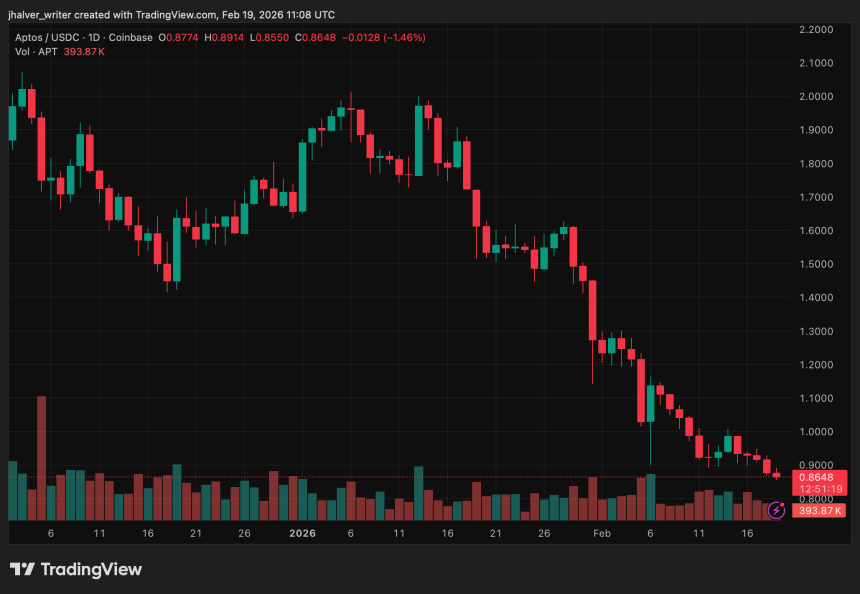
At the time of the announcement, APT was trading near $0.88, down about 4.5%, reflecting investor caution as the market considers the long-term effects of the tokenomics changes.
Hard Supply Cap and Lower Emissions Mark Structural Change
At the center of the proposal is the introduction of a hard supply cap of 2.1 billion APT tokens, a major shift for a network that currently has no maximum supply. About 1.196 billion tokens are already in circulation, meaning future issuance would gradually decline as the cap is approached.
The foundation also plans to reduce annual staking rewards from 5.19% to 2.6%, lowering the rate at which new tokens are created. A redesigned staking model may offer higher yields for longer lock-up commitments, aiming to maintain validator participation while reducing inflationary pressure.
In addition, 210 million APT tokens are proposed to be permanently locked and staked, removing them from liquid circulation while continuing to support network security. The changes collectively signal a move toward tighter supply discipline as the ecosystem matures.
Burn Mechanisms and Fee Adjustments Could Drive Deflation
Alongside emission cuts, Aptos intends to strengthen token burn dynamics. Transaction fees paid on the network are already burned, and a proposed tenfold increase in gas fees could accelerate the pace at which tokens leave circulation. Even after the adjustment, stablecoin transfers are expected to remain extremely low-cost.
Higher on-chain activity may further amplify burns. New applications, including fully on-chain trading platforms, are projected to generate sustained transaction volume, potentially creating conditions where tokens burned exceed newly issued supply.
The foundation is also exploring additional measures such as performance-based grants and a potential token buyback program, both designed to better align issuance with measurable ecosystem growth.
What the Shift Means for InvestorsFor investors, the proposed overhaul introduces a different economic narrative for APT. Reduced staking rewards may lower short-term yield opportunities, but tighter supply and expanded burn mechanisms could support scarcity if network adoption increases.
The timing is notable as a major token unlock cycle concludes in October 2026, expected to reduce annual supply unlocks by roughly 60%. Combined with declining grant distributions, the reforms aim to transition Aptos toward a model where long-term value depends more on network usage than subsidy-driven emissions.
Related Reading: Stellar Price Forecast: XLM Stabilizes After Dip, March Recovery Toward $0.20 in Focus
Whether the strategy succeeds will depend on governance approval and sustained ecosystem growth, but the proposal highlights a growing trend across blockchain networks: tokenomics design is becoming as critical as technology performance in attracting developers, institutions, and long-term capital.
Cover image from ChatGPT, APTUSD chart on Tradingview










 English (US) ·